


Want to know more?
Tell us your situation and a consultant will contact you in no time.
Contact us at

Vote coercion is defined as the act of pressuring a voter with negative or positive incentives to vote for an option that does not necessarily have to be the one of his or her choice. Coerced voting is not a problem exclusive to online voting, but affects all types of voting, including in-person and postal voting. Each medium (face-to-face, postal and online) has very different mechanisms to prevent vote coercion. For example, in a face-to-face ballot, a booth with a curtain is often used to allow voters to fill in their ballot and place it in an envelope without being observed.
Kuorum allows the ballot administrator to activate anti-coercion mechanisms - such as the ability to overwrite a ballot as many times as necessary before voting closes - which can be very effective, especially in election processes.
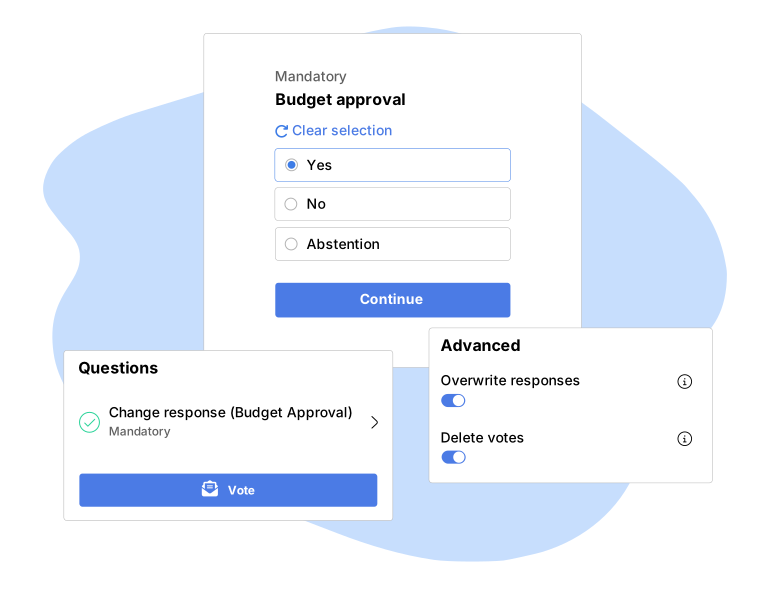
A vote is legitimate only if the result reflects what each person truly wants. That is why, in addition to guaranteeing that the vote is secret and that only those who are eligible to vote do so, we must ensure that no one can influence another person’s vote. Kuorum’s anti-coercion mechanisms are designed for just that: to protect the freedom of every voter when they vote from home, from the office, or on their cell phone—without a voting booth or a privacy screen.
Voting coercion is the pressure exerted on a voter to choose an option that is not their own, whether through threats or promises and rewards.
This is not a problem exclusive to online voting: it affects in-person and mail-in voting equally, and the most well-known forms of fraud—such as vote-buying or tampering with sealed envelopes—date back to long before the internet. What changes with each method is the tool used to combat it: for a physical ballot box, it is the voting booth; for online voting, it is the design of the system itself.
Kuorum incorporates security and privacy measures that help ensure that each participant can cast their vote freely, confidentially, and without external pressure :
Kuorum’s core mechanism is simple: as long as voting remains open, each voter can cast their vote again as many times as they want, and only the last vote counts.
Even if someone watches them while they vote, or forces them to choose a specific option, they can always log back in when they’re alone and record their true choice. Those who try to pressure voters can never be sure that the vote they saw is the final one, and that eliminates much of the incentive to pressure or pay for a vote.
Coercion only works if the person applying pressure can verify the result. That is why, after casting a vote, Kuorum provides the voter with a receipt containing a hash code: a unique, unalterable identifier that confirms the vote has been correctly recorded, without revealing how the voter voted.
Voters are assured that their participation counts, and no one can demand “proof” that they voted as requested. It is the combination of verifiability and secrecy that makes the system robust.
Anti-coercion mechanisms are especially recommended for elections and any voting process where relationships of dependency, hierarchy, or social pressure exist: union elections, elections for professional associations, associations, cooperatives, sports clubs, universities, or referendums with many participants.
The voting administrator decides whether to enable these mechanisms when configuring the vote, so each organization can tailor them to the risk level of its process.
Anti-coercion mechanisms are part of an online voting platform designed with security as a foundation. Kuorum has been helping public and private organizations hold elections and assemblies since 2013, and holds ISO 27001, ISO 9001, and National Security Scheme certifications at the highest level. These features are combined with secure identification, secret voting, and the platform’s other functionalities to ensure that every vote is unique, free, and verifiable.

Integrate with leading video conferencing tools to offer your remote constituents a seamless experience. Compatible with all platforms, such as Zoom, Teams, Webex and many more.


At Kuorum we help people around the world make collective decisions that matter. Tell us your goals and we'll tell you how we can help.


Tell us your situation without obligation and a consultant will contact you.


Vote coercion is any pressure exerted on a person to vote for an option other than the one they would have freely chosen. It can be negative (threats, reprisals, pressure from a superior or one’s social circle) or positive (money, favors, gifts, or promises in exchange for a vote). It has been present throughout the history of all voting systems and is now a crime in most democratic legal systems.
Mainly two: the ability to change one's vote as many times as desired while voting is open, and a receipt with a hash code that allows voters to verify that their vote has been recorded without revealing how they voted. Both of these features complement the secrecy of the vote and secure voter identification.
Yes. If voting is still open, you can log in again when you're alone and submit your actual decision. The vote you cast under pressure is superseded by the new one. That is precisely the purpose of this feature: to ensure that pressure from a third party is never final.
No. Although a voter may cast a ballot more than once, secure identification ensures that only those eligible to vote do so, and that each person’ s vote counts only once. Overwriting a vote does not multiply the number of votes; it simply replaces one vote with another.
Because whoever is exerting pressure cannot be sure that what they have seen is the final vote. If the person can change their mind later, paying for a vote or demanding one ceases to be a reliable investment. The certainty that the threat or payment served any purpose is eliminated.
No. After voting, you can download a receipt confirming that your vote has been recorded, but that receipt does not reveal how you voted. Therefore, no one can demand proof that you voted for a specific option.
The hash code is a unique, unalterable alphanumeric code associated with a vote. It allows you to verify that your vote has been recorded correctly, but does not reveal which option you chose. It combines verifiability (you can trust that your vote counts) with secrecy (no one knows how you voted).
Yes, and they reinforce each other. The secret ballot prevents a person from being linked to their choice, and the anti-coercion mechanisms prevent a third party from forcing or verifying that choice.
In the face of coercion, our anti-coercion system offers an additional safeguard that the voting booth does not: the ability to change one’s vote. The voting booth protects the moment when the voter selects the ballot, but it does not prevent someone from watching the voter before they enter, handing out pre-filled envelopes, or demanding to verify the result. In an online vote, even if such pressure exists, the voter retains the option to change their vote afterward.
The vote administrator. When configuring the vote, the administrator can enable these features based on the type of process and the level of risk; therefore, they are not required for all votes. They are especially recommended for elections.
For any process in which voters may be subject to pressure, and especially for elections—whether for unions, professional associations, organizations, cooperatives, clubs, universities, or political parties. When there is a relationship of dependence between the voter and the party that could exert pressure, this mechanism is most valuable.
Until the moment voting closes. Once voting closes, the last vote cast is considered final and can no longer be changed.
The logic is the same: you can change your vote as long as the voting period is open. In delayed voting—which remains open for hours or days—voters have the most opportunity to change their minds. Learn about the differences between delayed voting and real-time voting.
Yes. The option to overwrite a vote has been in use for years in major elections, such as Estonia's presidential elections, and is one of the most widely recognized measures against coercion in online voting.
Yes. Anti-coercion mechanisms are part of a legally valid online voting process, along with secure voter identification and vote traceability.

Schedule a 30-minute product demo with our experts
